No. I · Field Notes
Reading the Migration: A Guide's Almanac
James Sankale · April 2026
Fourteen years on the Mara have taught me that the wildebeest don't follow the calendar — they follow the rain. Here's what I actually look for, and when.
The wildebeest do not care about your annual leave.
I say this with great affection, and with fourteen years of evidence. Every season, guests arrive at Wilson Airport having engineered their entire year around a migration window they read about in a supplement, a blog, or a friend's breathless recommendation. They have booked the dates, cleared the calendar, and carried the anticipation for months. They step off the plane already listening for the thunder of hooves.
The Mara receives them warmly. Then it does exactly what it wants.
Every year, without fail, the emails begin arriving in April. "We have booked for the second week of July — is that good for the migration? Sometimes it is August. Sometimes in October. The month changes; the anxiety behind the question does not. Guests have done their research. They have read the roundups and the travel supplements, and what they have taken from all of it is a single, reassuring idea: that the wildebeest move on a schedule, that the schedule can be known in advance, and that with the right booking, the spectacle is guaranteed.
Twelve years on the Mara have taught me that this is only partially true — and that the partial truth is the dangerous part.
The herds do not follow the calendar. They follow the rain.
More precisely, they follow the grass that the rain produces, and the grass does not grow according to any date printed in a magazine supplement. It grows when the conditions are right. A strong rainy season in April holds the herds south into July. A dry spell in the north pulls them earlier than any forecast predicts. The crossings happen when the animals reach the bank — which is determined by grass and instinct refined across a million years of movement, not by peak season dates in a travel supplement.
What this means in practice is that reading the migration is a skill, not a calendar exercise. It is learned over years and across thousands of kilometres on the ground, and the guides who do it well are drawing on a kind of knowledge that no amount of research from a desk can replicate.
Here is what I look for, and when.
The Grass
Before I look at where the herds are, I look at where the grass is. The wildebeest are grazers above everything else. They are following protein, and protein, in the savannah, is green. In a season where the rains have been generous and the southern Serengeti holds colour into June, the herds will linger. In a dry year, they move earlier and faster. I watch rainfall reports from Tanzania from February onwards, long before most guests have begun packing.
The Columns
When the herds start moving north in earnest, they move in columns - long, dusty lines visible from kilometres away, pressing through the corridor between Tanzania and Kenya. When I begin to see column movement on reports from guides I trust in the Serengeti, I know we are within two to three weeks of serious action in the Mara. This is when I begin adjusting itineraries for guests already booked, sometimes shifting game drive timings, sometimes repositioning camps entirely.
The Rivers
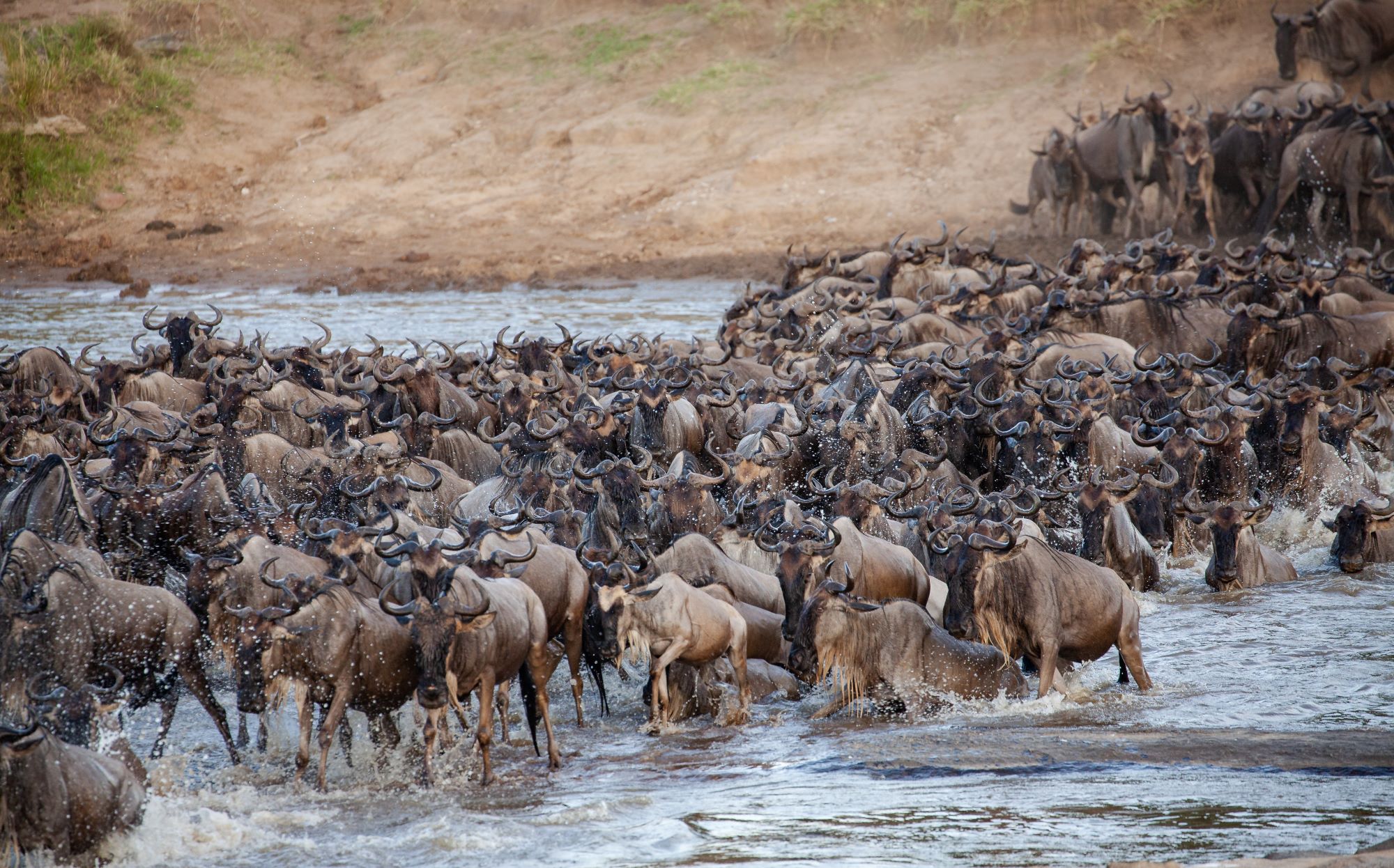
The Mara River crossings are not daily events. They are not even weekly ones. The herds will stand at the bank for hours - sometimes days - pacing, retreating, milling in their hundreds of thousands, before one animal finally commits and the rest follow in a roaring cascade of muscle and water and noise that is genuinely unlike anything else on earth.
The question I am always asked is: can you predict when a crossing will happen? The honest answer is: sometimes. The herds telegraph restlessness before they cross. There is a particular quality to the movement at the bank - a pressing forward, a concentration of animals at specific points - that, after enough years, you begin to recognise. I cannot tell a guest it will happen at ten o'clock on a Tuesday. But I can tell them that if we are at the right bend of that river on the right morning, we will be ready.
The year that changed my thinking
In 2019, we had guests booked for what should have been peak crossing season in August. The rains that year had been unusual - heavy and late - and the grass in the northern Serengeti was still thick and green well into July. The herds were not interested in moving. My guests spent three mornings at the riverbank and saw nothing cross. What they saw instead was the largest concentration of wildebeest I have ever witnessed in my career. An ocean of animals, stretching to every horizon, grazed quietly in the early light with the Mara escarpment behind them. One of my guests, a wildlife photographer with twenty years of experience, told me it was the most extraordinary thing he had ever seen in the field.
Not a single animal crossed that river the entire time he was there.
I tell that story to every new guest now. Not to lower expectations, but to raise them to a different level entirely. The migration is not a performance. It does not run on our schedule. It runs on its own ancient logic, shaped by rain and grass and instinct refined across millennia, and the job of a good guide is not to promise you the crossing but to put you close enough to that logic that you can feel it working.
Patience and timing are key. Come prepared to be astonished by something other than what you planned for. Approach the experience with patience and an open mind and allocate ample time for your journey, as the true astonishment may come from unexpected discoveries, beyond your initial expectations.
That is, in my experience, how the Mara tends to work best.
— About the author —
James Sankale
Lead Guide · Maasai Mara
James has guided on the Mara since 2014. KPSGA Silver-rated, raised in a Maasai homestead near the Loita Hills, he leads our river-crossing journeys between July and October.